 English


Why We Created the Self-Lifting Stacker: A Smarter Approach to Last-Mile Unloading
The Challenge Beyond Traditional Warehousing
In the material handling industry, most equipment innovations are typically centered around warehouses, factories, and distribution centers. However, through ongoing communication with logistics companies, truck drivers, and warehouse operators, we noticed a recurring operational issue occurring outside these controlled environments. A common question kept emerging during discussions:
What happens when goods arrive at the delivery site, but there is no unloading equipment available? This challenge is especially common in modern logistics operations where delivery points are increasingly decentralized and infrastructure conditions vary significantly.
Real Problems in Daily Delivery Operations
In many practical transport scenarios, unloading is still one of the least optimized stages of the logistics process. Traditional forklifts can no longer solve these pain points, while our self-lifting stackers are designed for such scenarios.
Operators often face situations such as drivers handling deliveries without additional manpower, customer sites lacking forklifts or unloading platforms, or temporary unloading solutions increasing both labor costs and waiting time. While transportation efficiency has improved considerably in recent years, unloading operations at the destination can still be dependent on external equipment, inefficient for small and medium-scale deliveries, or difficult in restricted or temporary working environments. These issues directly affect delivery efficiency and operational flexibility.
Rethinking Material Handling Equipment
Instead of focusing only on improving conventional forklifts, we approached the problem from a different perspective: What if the capability to unload could be integrated with the vehicle?
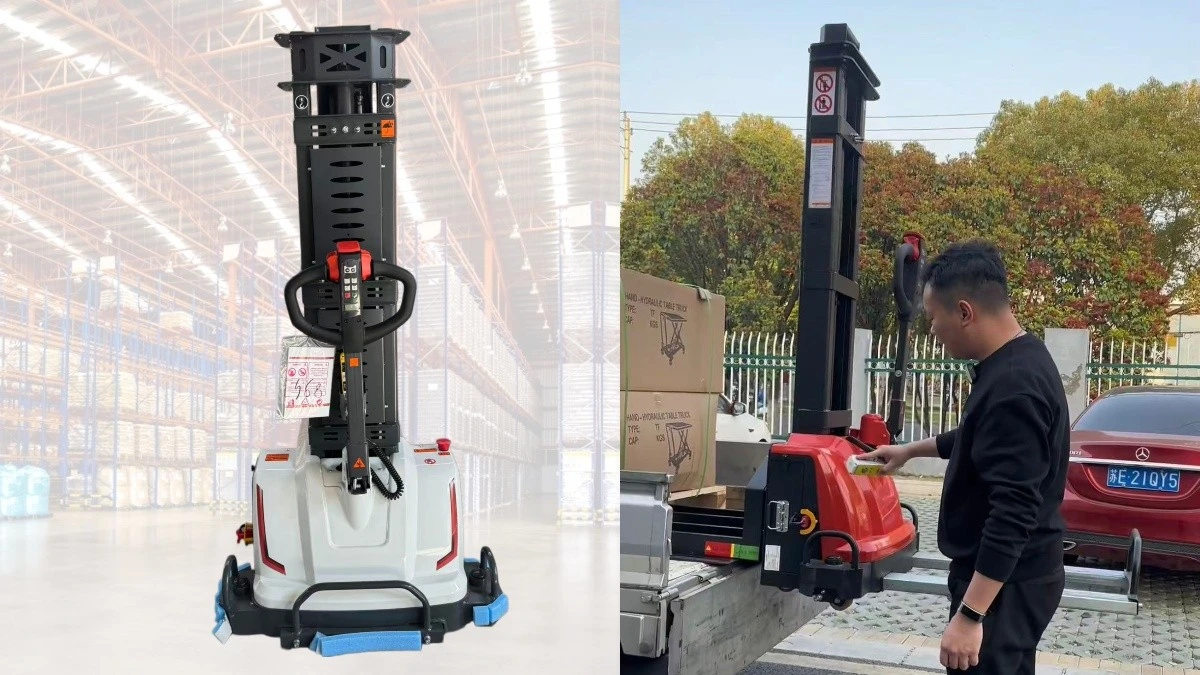
This idea became the starting point for developing a more flexible and self-contained handling solution — our flagship SES15 self-lifting stacker. This equipment was designed specifically for mobile unloading applications. The goal was not to create a larger machine, but a smarter and more adaptable one.
Based on these real-world requirements, QSLiFT developed the SES15 self-lifting stacker. Its application scenarios include: supporting single-operator unloading tasks, improving handling efficiency at delivery points, operating inside containers, truck beds, and confined spaces and reducing dependence on external forklifts or lifting equipment. With its compact design and integrated lifting structure, the equipment can move efficiently between ground level and transport vehicles while maintaining flexibility in mobile working conditions.
Key Design Priorities
Key Design Priorities During product development, practicality and operational adaptability remained the primary focus.
Several important factors influenced the final design.
Compact Mobility The structure was optimized for confined environments such as containers and truck compartments, where traditional forklifts may be difficult to operate.
Independent Power Supply A removable lithium battery system allows flexible charging and improves operational convenience in different working locations.
Practical Load Capacity The 1.5-ton load capacity was selected to match common palletized cargo requirements in daily logistics operations.
Easy Daily Operation The equipment was designed with simplified controls and minimal operational complexity to support efficient day-to-day use. Rather than focusing solely on technical specifications, the development process prioritized usability in real logistics environments.
Improving Efficiency in the Last Mile
Not every logistics improvement requires large-scale automation systems. In many cases, operational efficiency can be significantly improved by optimizing smaller but critical workflow stages — especially unloading. By integrating material handling capability directly into the delivery process, businesses can benefit from more flexible transport operations, reduced reliance on unloading infrastructure, faster turnaround times at delivery points and improved labor efficiency for single-person operations. For many logistics companies, these small operational improvements can create meaningful long-term value.
Continuing to Explore Real-World Applications
As part of this project, QSLiFT has also been documenting how the SES15 self-lifting stacker performs in practical working environments.
A series of application-focused videos will be shared through our social media channels, demonstrating real unloading operations and practical usage scenarios rather than only technical specifications.
We also welcome feedback from logistics professionals and equipment operators:
What is the biggest unloading challenge in your daily operations?
Explore all our lifting equipment and real case studies on qslift.eu.
To learn more, view full specifications of the SES15 Self-Lifting Stacker.
Browse all material handling products from QSLiFT and visit our official site: qslift.eu